For most of the past decade, with interest rates near zero, investors had little to lose by backing a company that promised profits five or ten years down the track. Cash in the bank earned almost nothing, so waiting for a distant payoff cost very little.
That has changed. Savers can now earn a 4–5% return on cash, and Australian government bonds pay more than 5%. Lenders and savers are again being paid to be patient. That creates the other side of the coin: anyone who needs to borrow or raise money must now move faster, because the people funding them have a well-paid alternative.
The simplest way to see this is to ask what a dollar of profit promised in ten years is worth today.
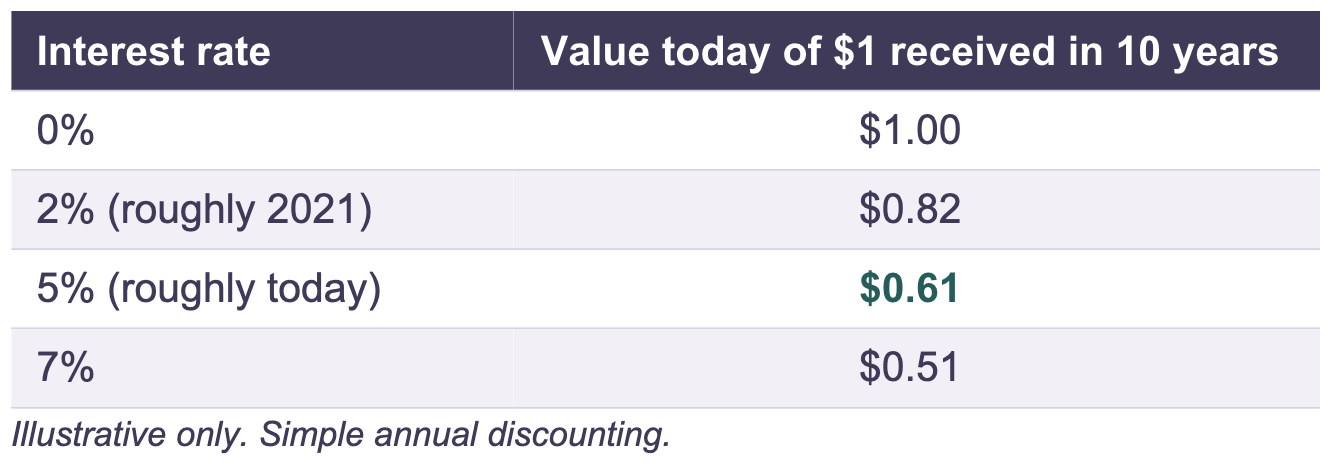
The higher rates go, the less a distant promise is worth, and the harder it becomes to raise money on one. The effect is not linear. Each additional rate rise bites hardest on those whose payoffs are furthest away.
Why the runway just got shorter
In start-up language, a company’s “runway” is how long it can keep operating before the cash runs out. For businesses that are losing money or spending heavily ahead of revenue, higher rates shorten that runway in three ways.
Borrowing costs more. Interest payments eat into the cash pile faster, leaving less to fund the actual business.
The next raise is dearer. Lower valuations mean giving away more of the company for the same money, or failing to raise at all.
Investors’ patience has a price. When cash pays 4–5% risk-free, an investor needs a far better reason to fund a business that may not turn a profit for years.
In October we saw all three play out, from Silicon Valley to the ASX.
The borrowers in a hurry
The clearest example is the “neoclouds”, the newer companies that build data centres and rent out computing power for artificial intelligence. They spend billions on chips and buildings today, often funded with debt, in the hope of earning it back over many years. That is exactly the kind of business that is punished by higher interest rates.
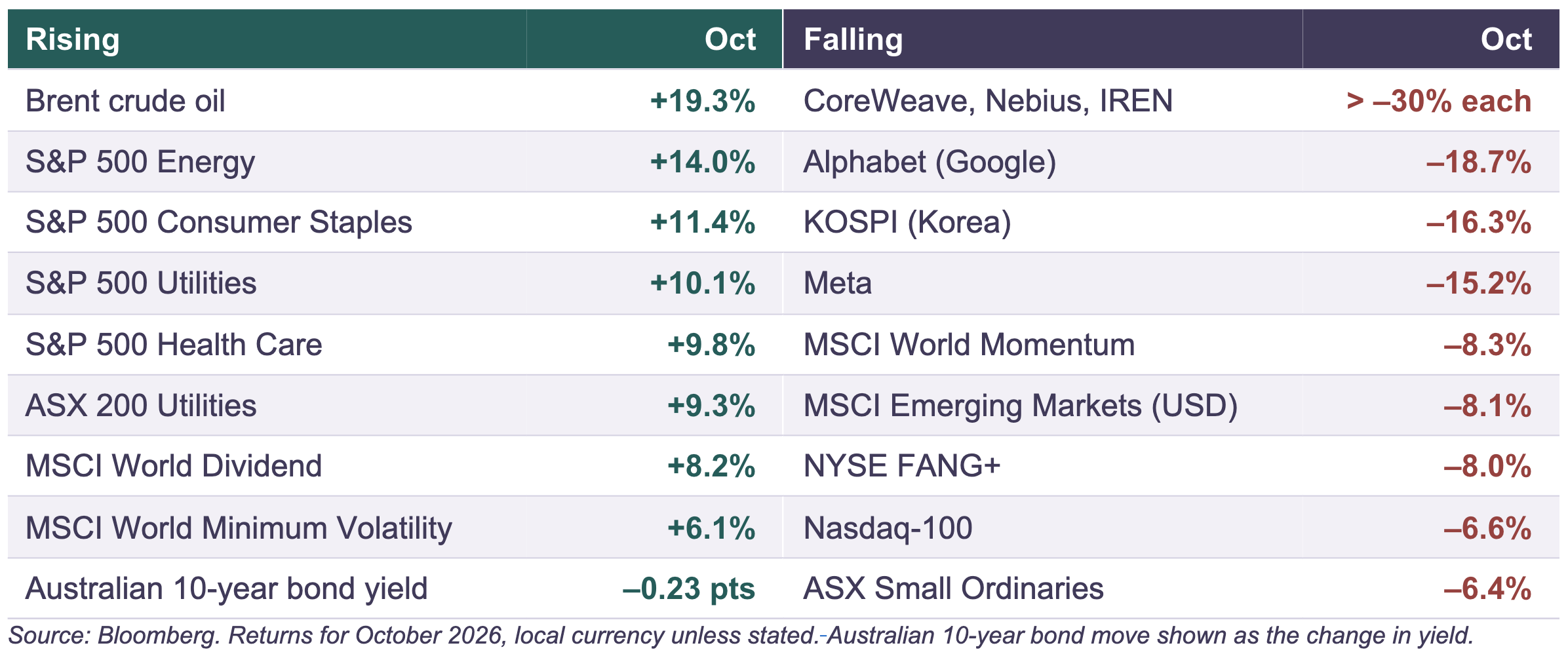
Shares in the three best-known neoclouds each fell by more than 30% in October. CoreWeave is now about 70% below its June high, IREN 68% below its peak and Nebius 46%.
Yields on CoreWeave’s longer-dated bonds rose above 15%, a level normally associated with financial distress.
SK Hynix pulled the planned US listing of its Solidigm unit, citing market volatility, and Korean cloud provider Elice Group fell 30% on its first day of trading.
Korea’s KOSPI, where AI memory-chip makers Samsung and SK Hynix carry the most weight, fell 16.3% in October and is now 37% below its peak.
None of this means demand for AI computing has disappeared. It means investors are no longer willing to fund every promise at any price, and are demanding to see the cash sooner.
Close to home: Firmus and NextDC
Australia has had its own lesson. Firmus, an AI data centre developer backed by Nvidia and Blackstone, planned to raise around $5 billion in one of the largest floats in ASX history, at a valuation of about $30 billion. It withdrew the offer on 9 October and is now exploring a smaller private raise.
The numbers explain the hesitation. Firmus reported about $51 million of revenue in its 2026 financial year. It has a pipeline of 912 megawatts of data centre capacity, of which 46 megawatts has been built. Almost all of the value sits in the future, and at today’s interest rates, the future is worth less.
A fortnight later, NextDC, the ASX’s largest listed data centre operator, fell about 40% in a day after cutting its earnings guidance because of a delay in power supply to a new Melbourne facility. A delay that might have been shrugged off in 2021 is now very expensive. When money costs more, time is money.
Even the giants are being asked to hurry
This is not only a story about small, speculative companies. The world’s largest technology businesses have moved from funding AI out of their profits to spending more than they earn.
Alphabet (Google) reported negative free cash flow of US$9.1 billion for the September quarter, its second negative quarter in a row, as AI spending outpaced revenue. Its shares fell about 12% on results day and 18.7% over October, its worst month on record, erasing around US$758 billion of market value.
Meta fell 15.2% in October after it also reported negative free cash flow and lifted its spending forecast. The cost of insuring its debt against default reached a record high, as it did for Oracle and Nvidia.
SpaceX fell 10.7% in October. It is now 33% below its June high and trading slightly below its IPO price, so investors who bought into this year’s float are back where they started.
Alphabet and Meta remain highly profitable and investment grade. But the market’s message is clear: even the biggest borrowers must now show a return sooner. Patience is no longer unlimited.
Main Street feels it too
Households and small businesses are borrowers as well, and they are being squeezed from two directions.
Inflation is forcing harder choices. In Australia prices rose 4.3% over the year to September. Fuel jumped 9.4% in the month and housing costs were up 5.2% on a year ago. With mortgage costs higher, discretionary spending is being cut.
Business failures are rising sharply. ASIC data shows company insolvencies at five-year highs, up more than 60% on last year, led by construction and hospitality.
Private credit is being tested. Property developer Bathla Group collapsed owing about $3 billion to some 40 lenders. On 30 September, Metrics froze redemptions on three of its funds due to an audit delay and valuation adjustments up to -12%. Selectivity is not confined to listed markets.
The great rotation
The result is a sharp rotation in markets. Money is moving away from businesses that promise returns later, towards those that deliver cash now.
October showed it clearly. Global shares overall barely moved, with MSCI World down 0.8%. Underneath, the MSCI World Dividend index rose 8.2% while the Momentum index, dominated by last year’s technology winners, fell 8.3%. That is a 16-point gap in a single month. Bond yields fell across the major markets, so bond prices rose.
The returns are already in the rear-view mirror
Share markets, and the return figures investors see on their statements, have not yet caught up with this shift. Most of the past year’s gains came in a single burst: in April and May 2026, the Nasdaq-100 rose 28% and the S&P 500 rose 16%. Since then, markets have gone sideways or worse. Over the five months to October, the Nasdaq fell 6.4%, the S&P 500 was flat and the ASX 200 rose 2%.
The table below makes this plain. It shows the average monthly return, looking back from 31 October over periods from one month to twelve.
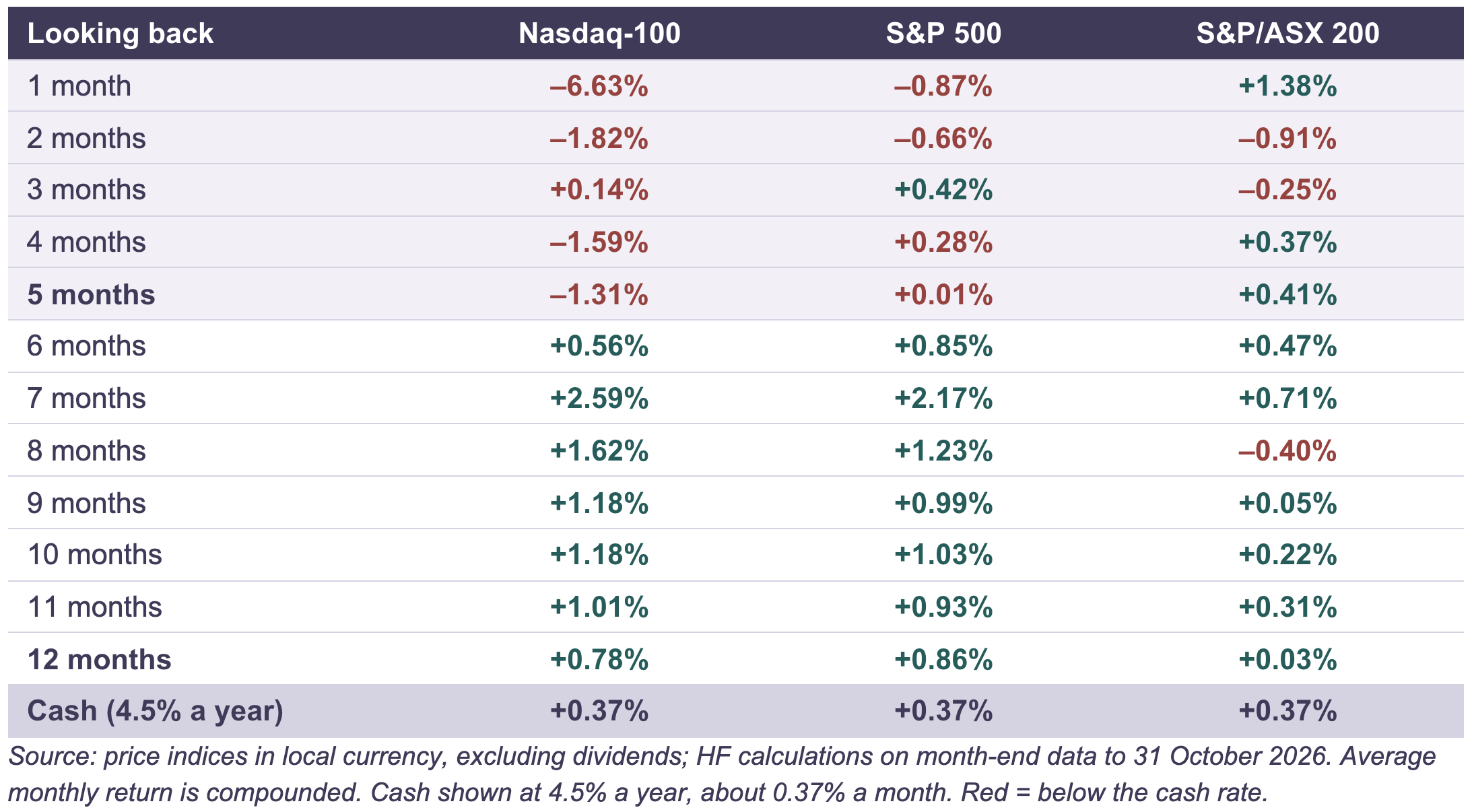
Read the table from the bottom up. Over twelve months, the US indices have averaged a respectable 0.8–0.9% a month. But the closer you get to today, the weaker the numbers become. Over the past five months, the Nasdaq has lost an average of 1.3% a month, the S&P 500 has made nothing, and the ASX 200 has made about 0.4% a month, roughly what cash pays. The strong numbers only appear once April and May come into the window.
That tells us where the reported numbers are heading. Today’s 6-month return still includes May’s gains. At the end of November, May drops out, and over the following months April and May drop out of the 12-month figures too. Unless markets rally, the returns investors see on their statements will move down towards these recent averages.
In other words, the lack of recent returns is already a fact. It just has not shown up in the numbers yet. When it does, we expect many investors to start asking why their portfolios have stalled, at the same time as cash and bonds are quietly paying 4–5%.
The patience test
A market that goes sideways for a year earns nothing. A term deposit or a quality bond earns 4–5% over the same period. That gap is the price of impatience, and many investors will soon see it on their statements.
What this means for portfolios
We are not calling the end of the AI cycle. Demand for computing power is real, and some of today’s heavy spenders will become tomorrow’s great businesses. But the terms have changed: Capital has a price.
We have already acted. Earlier in October, we made our Dynamic/CFS models more defensive. Our approach is to stay on the right side of this trade: to be the patient lender, not the impatient borrower.
Favour businesses that fund themselves. Companies with strong cash flow do not need to ask anyone for money, and higher rates hurt them least.
Be paid while we wait. Bonds and quality income assets now offer genuine returns, as we set out in last month’s piece, Every Drop in the Bucket.
Be selective. As the gap between winners and losers widens, owning the whole market matters less than avoiding the companies whose runway is running out.
Set expectations early. Headline returns are likely to look weaker from as soon as the end of this year, even if markets hold their ground. Better that investors hear it from us now than discover it on a statement later.
The bottom line
The higher interest rates go, the more attractive it is to lend and the more it costs the companies that borrow. We are positioning our Dynamic/CFS portfolios to benefit from this shift.
More like this