FY2026: A year of records and reversals
The 2026 financial year delivered a remarkable run of records, matched only by the ability to take them back. Beneath the headlines sat a single story: a year in which inflation, geopolitics, central bank policy and the AI build-out stopped behaving as separate themes and converged into one.
Read in isolation, any of these events was a talking point. Read together, they reset the regime.
The everything rally, and its limits
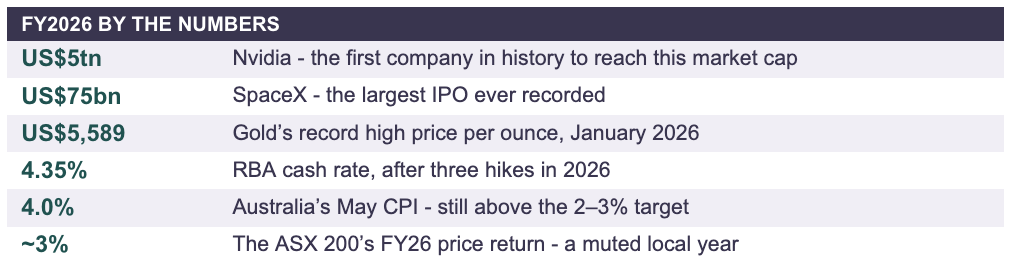
Markets spent much of the year minting milestones. Nvidia became the first company in history to reach a US$5 trillion valuation, later touching US$5.5 trillion. SpaceX listed in the largest IPO ever recorded: raising roughly US$75 billion at around a US$1.75 trillion valuation it eclipsed Saudi Aramco’s long-standing record several times over. Gold broke US$5,000 an ounce for the first time and set an all-time high near US$5,589, in a year in which it rose more than 60% at its peak. Even the speculative fringe joined in: Bitcoin reached a record near US$126,000 before suffering the largest single-day liquidation on record and giving back roughly half its value. The build-out’s scale showed up in capital markets too. Alphabet sold a rare 100-year bond, the first century bond from a technology company since 1997, to help fund up to US$185 billion of capital spending. Hyperscaler capex is collectively set to exceed US$600 billion, with access to power, not chips, now the binding constraint.
Yet the warning signs remained in plain sight: the seven mega-cap technology names still make up about a third of the S&P 500, and through the first half of 2026 they underperformed the index. Dominance, this year, meant structural weight rather than return leadership.
One shock reset the regime
The financial year’s turning point was geopolitical. Conflict in the Middle East pushed oil sharply higher - Brent spiked above US$115 a barrel in March - reigniting inflation just as it appeared to be fading. Australian headline inflation reached 4.6% in March, its highest since 2023, and the RBA reversed course decisively, hiking three times to lift the cash rate from 4.10% to 4.35%, its first increases since 2023 and an almost complete unwinding of the easing delivered in 2025. The era of synchronised global policy ended with it: under new Chair Kevin Warsh, the US Federal Reserve sat on hold while markets priced the possibility of hikes rather than cuts. This left Australia among the developed-world outliers tightening into the cycle, while lending support to the Australian dollar. Policy out of Washington proved noisier than it was consequential: the US Supreme Court struck down the bulk of the administration’s tariffs in February, and markets largely looked through it.
The view from home
For all the global drama, Australian investors had a comparatively muted year. The ASX 200 finished the financial year near record territory but delivered only a low-single-digit price return: around 3%, or closer to 7% once dividends are counted. Materials names surged with commodity prices while technology and healthcare fell sharply. Underlying inflation stayed sticky: the trimmed mean of around 3.6% was still above the 2–3% target, despite the headline rate easing to 4.0% by May. Unemployment drifted up to 4.5%, its highest since 2021.
Two domestic policy shifts now move from announcement to reality: from 1 July 2026 the new Division 296 tax adds an impost on superannuation earnings above $3 million, and from 1 July 2027 negative gearing will be wound back for future residential purchases, in what some have called the most significant tax reform in 25 years.
The year ahead
What comes next is less about whether the Middle East de-escalates than about how quickly its effects fade. The truce is already showing up in markets: crude has retreated to pre-war levels, unwinding much of the energy spike that drove the inflation scare, relief that should pull Australian headline inflation lower over the coming months. The open question is whether it is enough. Underlying inflation remains sticky and the labour market firm, so the RBA has kept a tightening bias, explicit that with rates on hold at 4.35% the next move is more likely a hike than a cut; the major banks are split on whether one more lands in 2026, and few expect relief before 2027. The clearest threat to that path is the fragility of the Middle East truce, and its potential to send oil higher again.
Beyond energy, China has trimmed its growth target to its lowest in decades, which may weigh on resources and the terms of trade. Furthermore, the durability of the AI capital cycle and the concentration it has created, remains the key global swing factor.
For diversified portfolios the implication is continuity, not reinvention: higher-for-longer rates, real-asset resilience, and selective rather than wholesale risk-taking.
The through-line:
For a diversified, long-term portfolio, most of this year’s records and reversals were noise that resolved into a single signal: inflation and interest rates higher for longer.
The value lies in not chasing each headline.
The round trip
The year’s signature was a climb to fresh highs followed by a pull-back into 30 June. Highs landed at staggered points (Bitcoin in October, gold in late January, oil in March) before broad-based softening into year-end. The equity indices held near their highs; the round-trip was sharpest in gold, Bitcoin and oil.
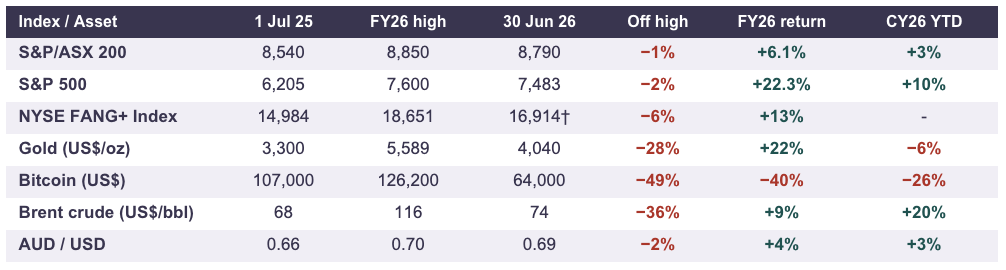
Indicative levels and returns, price/spot basis, rounded; compiled from public data to 30 June 2026 (ASX 200 total return ≈ +7% incl. dividends). † NYSE FANG+ Index level as at 30 Jun 2026; its high is intraday, while the −5.8% year-end drawdown and −22.8% maximum drawdown are on a closing basis. To be reconciled to HF’s data source before publication.
Under the hood: The FANG generation
The mega-cap technology names that grew out of the old “FANG” grouping - now the “Magnificent Seven” - make the point most clearly. The NYSE FANG+ Index rose about 13% over the financial year (14,984 to 16,914), yet that placid headline masked violent rotation beneath it: a maximum drawdown of −22.8%, and a close 5.8% below its peak. The pain arrived at different times for different names rather than all at once, so the index absorbed successive air-pockets while still grinding higher. Leadership changed hands as the year wore on: Alphabet was the only member to beat the S&P 500, while several former winners fell hard, including Microsoft, which was down 23% for the calendar year after June delivered its worst month since 2000. The group added just ~3% in the first half against the index’s ~10%, having peaked near US$22 trillion (about 36% of the S&P 500) in October 2025. Dominance, in other words, kept changing hands - structural weight, not durable return leadership, is what the concentration now buys.
This matters for how we think about the next phase. An index that keeps its return by rotating its leadership internally is not the same as an index compounding on a durable growth thesis and when concentration this heavy starts changing hands as often as it did this year, it is usually a signal that the market is already pricing a broader distribution of winners than the headline names suggest. We don't try to pick which name inherits leadership next; we manage the risk that comes from a small number of stocks setting the direction for an entire benchmark. Concentration risk of this kind isn't solved by timing a rotation, it's managed by not needing to.

Price basis, 1 January to 30 June 2026. Amazon, Meta and Tesla sat between the leaders and Microsoft.
More like this