Another drop in the bucket
Why each rate hike makes bonds and long-duration assets look more attractive from here
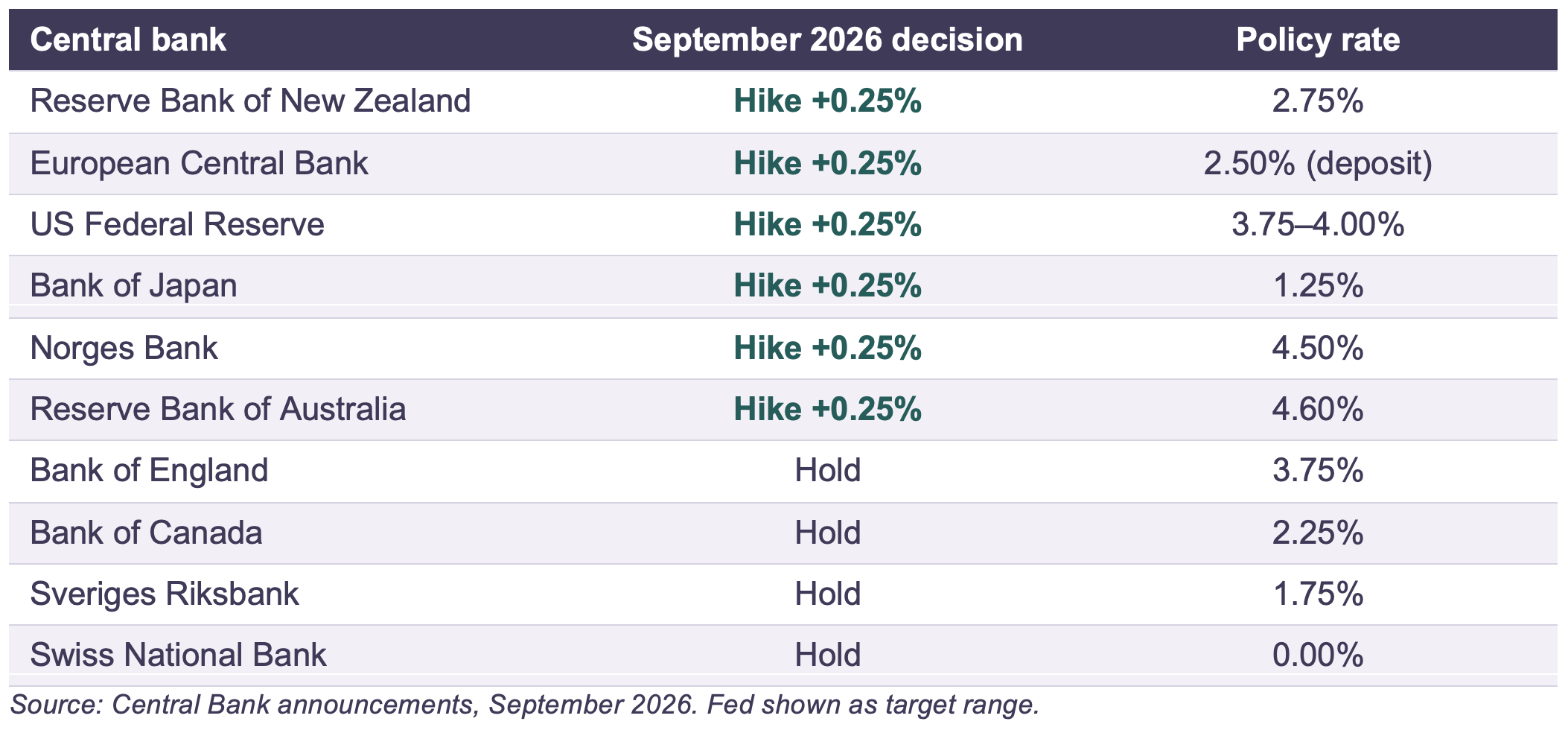
A rare moment of synchronised tightening
Interest rates have risen at home and abroad. In September, six of the G10 central banks raised their policy rates, including the Reserve Bank of Australia, which lifted the cash rate to 4.60%, its highest level since 2011.
That kind of alignment is unusual. Global, regional and national economies rarely move in lockstep. At any given time, one central bank is fighting inflation while another is supporting a slowing economy, because each is operating at a different point in its own cycle. When most of them move in the same direction in the same month, it tells us the pressure is broad-based. In this case, an energy-driven inflation shock is the common thread.
Why higher rates hurt long-dated assets
Higher rates have an obvious negative impact on duration-sensitive assets, most notably bonds. But the effect extends to any asset whose value depends on cash flows received over long periods.
The principle is simple: the further into the future an asset’s cash flows emerge, and the larger they are, the more its price moves when interest rates change. A dollar received in ten years is worth less today when rates are higher, because the discount rate applied to it is higher. Bonds, infrastructure, property trusts and dividend-paying shares all share this sensitivity to varying degrees.
Duration in one line
Duration measures how sensitive a bond’s price is to changes in yield. A portfolio with a duration of 6 will fall roughly 6% if yields rise 1%, and rise roughly 6% if yields fall 1%.
The last decade: A perfect storm for bonds
The negative headlines about bond performance over the past decade are well founded. Bonds faced a perfect storm, and it is worth understanding why.
They started expensive. Bond prices move inversely to yields. Australian 10-year yields fell below 1% in 2020 and sat around 1.5% through much of 2021, which meant bond prices were close to record highs.
Rates then rose a long way, quickly. Central banks lifted rates aggressively from 2022, pushing yields up and prices down.
There was no income cushion. With yields so low at the outset, the coupon income was too small to offset the capital losses. That is what turned a normal rate cycle into an unusually painful one.
Investors who judge bonds solely by that experience are, in our view, looking in the rear-view mirror.
Today is not 2021
The starting point has changed materially. The Australian 10-year government bond yield reached around 5.4% in mid-September, its highest level since 2011. That shifts the outlook in two important ways.
Income is attractive again. Over the long run, a bond portfolio’s future return is highly correlated with its starting yield. Higher entry yields point to better returns over the coming decade than investors received over the last one.
Cash is rewarding savers. With the cash rate at 4.60%, savers are finally earning a meaningful return on deposits.
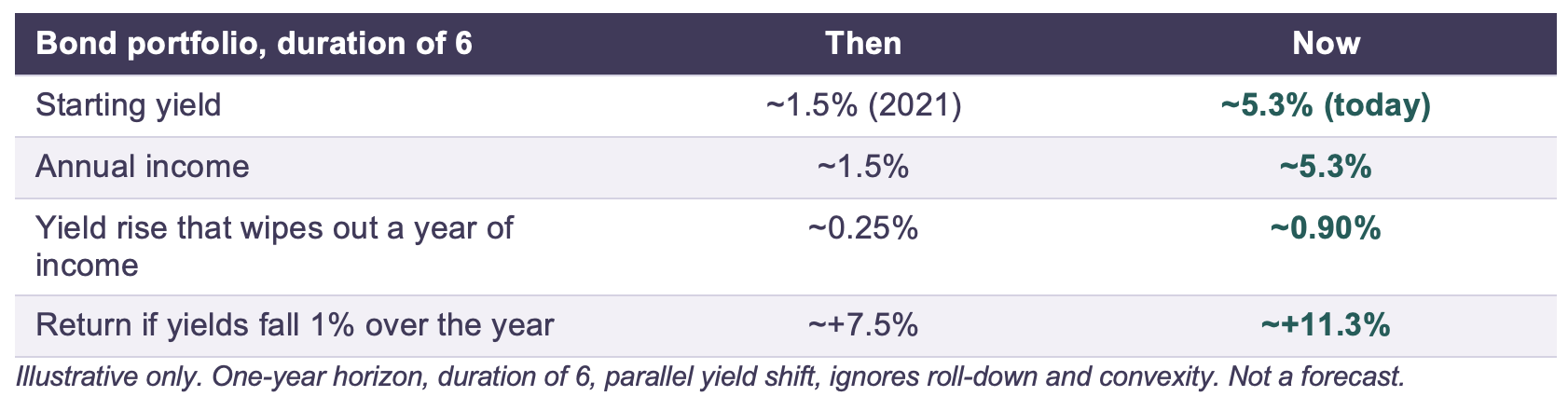
The income cushion also matters. A higher starting yield means yields must rise much further before income is fully offset by capital losses, and the upside is greater if yields fall.
A blunt tool with broad consequences
Interest rates are often described as a blunt tool. They cannot be aimed precisely at the parts of an economy that are running too hot. Instead, they affect everything at once. Households with mortgages, many of which were already stretched after the 2022–23 hiking cycle, take a hit along with the sectors the central bank is actually trying to cool.
Higher rates also raise the cost of capital. Put simply, it costs more to borrow money, whether to fund future growth or to pay for current spending. That has two consequences worth watching:
Government budgets come under pressure as debt servicing costs rise, constraining spending.
Corporate investment becomes more expensive. Capital-intensive projects such as data centre builds face a higher hurdle when the cost of funding them rises.
When the bucket overflows
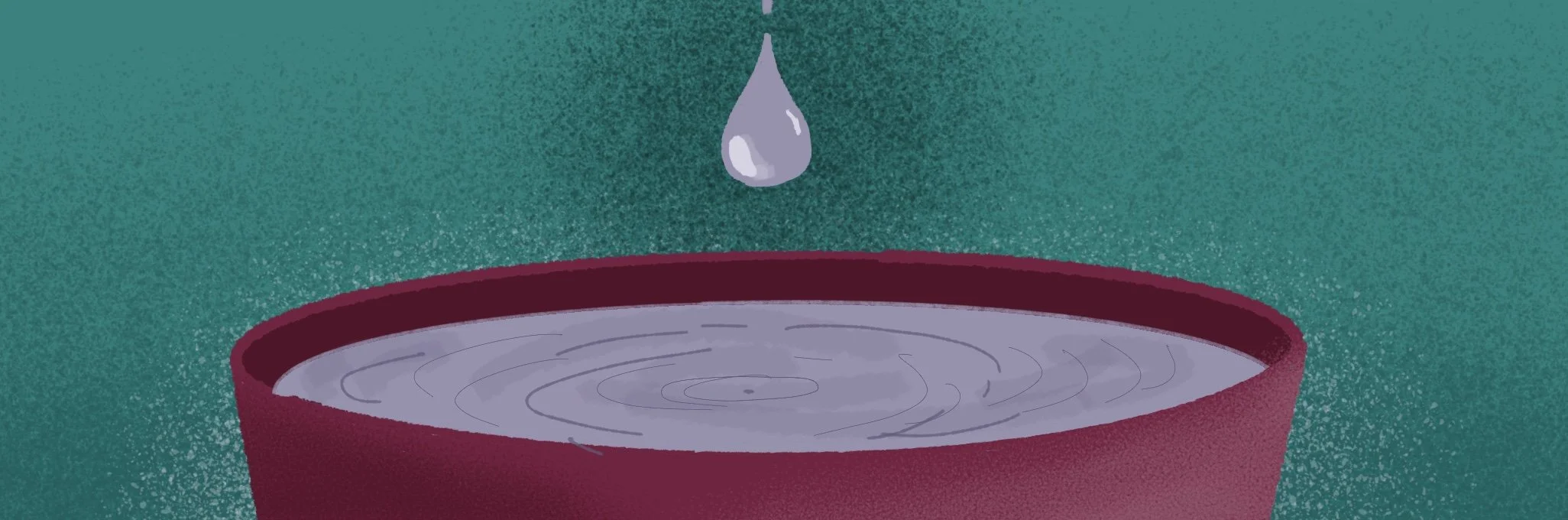
Each rate hike adds a little more water to the bucket. The economy absorbs the pressure for a while, and it can look as though higher rates are doing little harm. But at some point, and no one knows exactly when, the bucket overflows. Stresses emerge slowly at first, then in torrents.
That is typically when the economic cycle turns down and central banks cut rates to support activity. At that point, lower-risk, higher-yielding assets such as Australian government bonds tend to rally as their yields fall towards the new, lower cash rate. Because prices move inversely to yields, falling yields deliver capital gains on top of the income already being earned.
The asymmetry
At today’s yields, investors are being paid a solid income to wait. If yields rise further, that income absorbs more of the loss than it could in 2021. If the cycle turns and yields fall, the capital gain adds to the income. Each additional hike improves that trade-off.
What this means for portfolios
We are not saying we have reached the point where interest rates reverse. Inflation remains the central banks’ priority, and further hikes are possible, including from the RBA. Long-duration assets can still fall further in the near term if yields keep rising.
Our point is narrower: with each additional rate hike, bonds and other long-duration assets, such as dividend-paying shares, infrastructure and listed property, become more attractively priced and are better placed to perform over the years ahead.
At Human Financial we are skewing our allocations in this direction in our Dynamic portfolios. We are doing so progressively and with discipline, rather than trying to call the precise turning point, adding to duration and quality income assets as yields rise and the forward return outlook improves.
More like this